Ferddie's World

Thursday, April 07, 2011

Tree Planting at Mater Carmeli School, Novaliches!

March 31 marked the Pre-Elem Parent-Teachers’ Association last major activity for this school year 2010-2011. It was a tree planting activity for the kids in the Pre-Elementary Department. Dengue cases have continued to rise in the country and many parents like me and my wife Odette were understandably concerned about this persistent health danger.

As a response to this menacing health threat, officers of the PTA and the school administration agreed to have this tree planting activity along with the children of known mosquito repelling plants at the pre-school grounds.

Actually, the plants chosen were not really “trees”. One is a shrub called Malvarosa and the other a bush called Lemongrass.


Malvarosa (Scientific name: Pelargonium graveolens)


A small branching hairy shrub, Malvarosa plants are also known by its other name, Rose geranium (English) most probably due to their fragrantly rose-scented leaves.

Cultivated primarily for its aromatic, medicinal and ornamental uses, its flowers and leaves are considered edible, the latter used as condiment, tea or used as flavoring in deserts, jellies and even vinegar. A remedy for cough and stomach aches, it is also used to stop bleeding, wound healing and for its antibacterial properties.


Lemongrass (Scientific name: Cymbopogon citratus)


Native to the Philippines, Lemongrass (‘tanglad’ in Tagalog) is a bush or may be described as a tall perennial grass. A related species, citronella grass (Cymbopogon nardus and Cymbopogon winterianus) is similar to lemongrass but grows to 2 meters and has red base stems. Like Malvarosa plants, lemongrass is also used as an insect repellent and air freshener. Similarly, lemongrass plants have multiple uses in the kitchen. It is served as tea or included in fish soups and is often used as an ingredient in preparing Thai curry paste.


My wife Odette and Teacher Rosel Jimenez distribute the plants to the Prep students


The students including my daughter Faith start to transfer the plants to garden pots


Teacher Marilyn Luteria (Faith’s classroom adviser wearing a red orange shirt) help the kids replant


Placing garden soil on the replanted Malvarosa


Fragrantly scented mosquito repellents are now in place


Faith carefully waters the Malvarosa shrub


After the planting activity, Faith and the other students go back to the classroom

for graduation ceremonies practice


View of the blue sky and trees while lying on the Pre-Elem playground slide


All’s well and ends well.

The kinder students will have their own tree planting activity in the afternoon. Hopefully all the plants will be well maintained by the students, teachers and non-teaching staff so that the benefits of having these plants will go beyond this batch of pre-elementary students. It is hoped that these activities will also spur the participation of the elementary and high school departments so that everybody can contribute in the fight against dengue, making Mater Carmeli School-Novaliches a better and safer place to learn and grow in, during those early formative years.


Labels: ,

Thursday, March 24, 2011

Who's afraid of the post "Extreme Supermoon" 2011?

Many people have recently been talking about the super moon and how it was suppose to wreak havoc by triggering unnatural disasters around the globe.

I didn’t get to really observe the moon last March 19 (or March 20 for that matter). But one evening last weekend, I did see the moon quite magnificently clear, considering it has been cloudy for the past few days over the Philippine skies.

Remembering this beautiful scene, I stayed up last March 21 to take some pictures and catch a glimpse of the so-called ‘supermoon’ at least near its great closeness to the earth.

What is a supermoon? I learned the term was coined by a “certified professional astrologer”, Richard Noelle based in Arizona, USA in an article he wrote over 30 years ago.

Noelle describes a ‘supermoon’ as:

“…a new or full moon which occurs with the Moon at or near (within 90% of) its closest approach to Earth in a given orbit. In short, Earth, Moon and Sun are all in a line, with Moon in its nearest approach to Earth. At any new or full moon, Earth and Moon and Sun are all in a line: Earth is in the middle in the full moon alignment, while the new moon happens with Moon in the middle. This coming together in an alignment is technically termed a syzygy. Sometimes - from a few times to a half-dozen times in a given year - these alignments also happen when the Moon is in its perigee, or closest approach to Earth. Astronomers call this very special alignment a perigee-syzygy. I call it a SuperMoon – which is a whole lot easier on the tongue.” (His latest print article on the subject appeared in the October-November 2007 issue of the Mountain Astrologer)


Apparently, some media reports have it completely wrong when they say that the last supermoon occurred some 18 years ago. On the contrary, there are (on the average) around 4 to 6 supermoon occurrences in a year. The March 19, 2011 is the closest supermoon of the year (2nd supermoon this year) but not by any means neither the first one in 18 years nor the first extreme supermoon during the same period. According to Noelle, the previous extreme supermoon happened only last January 30, 2010.


Still, the supposed connection of the Moon with both oceanic and crustal tides has in turn led to assertions that the supermoon phenomenon may be correlated with amplified risk of events such as earthquakes and volcanic eruptions. Nonetheless, the so-called evidence of such association is widely viewed to be unpersuasive.

According to Noelle, he believes that within three days before and three days after a supermoon, the Earth is more exposed to natural disasters such as extreme coastal tides, severe storms, volcanic eruptions and strong earthquakes.

He further states that Supermoon solar eclipses tend to have “a wider sphere of impact” stretching about a week before and after the exact syzygy. If that is the case, it then tends to imply a causal relationship with powerful natural disasters such as the Tōhoku earthquake of 2011 and the Indian Ocean earthquake and tsunami of 2004.


Some Dates to Ponder: Causation or Coincidence?

Hurricane and tidal surge that struck Galveston, Texas (September 8, 1900)

Supermoon (September 8, 1900)

Ashgabat, Turkmenistan 7.3 Richter scale earthquake (October 6, 1948 – within three days of a supermoon, allowing for time zones)

Mount Pinatubo eruption (June 16, 1991 – within three days of a supermoon)

Supermoon (Dec. 31, 2009)

Haiti 7.0 Richter scale earthquake (Jan. 12, 2010)

Extreme Supermoon (Jan. 30, 2010)

Christchurch earthquake (Feb. 22, 2011)

Supermoon (Feb. 22, 2011)

Hawke’s Bay earthquake (Feb. 3, 1931)

Supermoon (Feb. 3, 1931)


For this March supermoon Noelle predicted "a surge in extreme tides along the coasts, a rash of moderate-to-severe seismic activity (including Richter 5+ earthquakes, tsunami and volcanic eruptions), and most especially in this case a dramatic spike in powerful storms with heavy precipitation, damaging winds and extreme electrical activity. Floods are a big part of the picture in this case, although some of these will be dry electrical storms that spark fast-spreading wildfires."

By God’s grace, the only “major disaster” my family experienced that weekend was when our electric stove conked out that Sunday forcing me to immediately buy a new one. I didn’t hear of any major natural catastrophe anywhere in the world, days after the 19th or the 20th. Noelle though mentioned lately of wildfires in Colorado last March 22 after the occurrence of storms in the area.

Some studies (which include articles from the Berkeley Seismological laboratory and the U.S. Geological Survey) have reportedly seen a weak correlation between lunar activity and shallow, very low intensity earthquakes. On the other hand, no evidence has been gathered to establish any correlation with major earthquakes. [It has been cited that the Tōhoku earthquake and tsunami (2011) is the only earthquake of 8.0 magnitude or greater to have occurred within 2 weeks of the 14 extreme supermoons from 1900 to the present date]


Already regretful of missing to observe the supermoon of March 19/20. I promised myself to take some time and document my early post-supermoon observation.

For more than an hour, I gazed at the moon between the final minutes of the 20th to the early hours of the 21st. Quite literally, it was a pain in the neck! There I was at our home’s driveway, trying to take decent pictures of the moon with my humble 10 mega pixel digital camera which hid behind a large mass of cumulus clouds. I thought I would never get a good picture of the moon but as the first minutes of the 21st came to pass, the moon eventually came out and gave me some spectacular shots to share in this blog.


I took this picture of the supermoon at exactly the start of the midnight hour (12:00 am) of March 21


Overcast skies continued to cover the supermoon (picture taken at 12:01 am)


The moon starts to show some of its brightness


I call this one – triple supermoon


The moon begins to go out of the clouds


Spectacular display of moonlight amidst a field of cotton-like clouds


‘Supernova’ moon


The post supermoon using different camera settings


The red moon


Cloudless bright supermoon


Bright red supermoon rising


‘Dancing’ supermoon


‘Chicken head’ supermoon


So was there a real super threat or just super hype?

Supermoons are here to stay. For their aesthetic brilliance, I wish they do stay the way they are. No more, no less. Let’s hope future scientific studies will finally and convincingly put to rest the fantastic claims of ramblers and soothsayers alike and let the plain truth prevail.


Labels: ,

Thursday, October 08, 2009

The day Typhoon 'Ondoy' rained on my 42nd Birthday

Sept. 26, 2009…for me, it was the date of my 42nd birthday. Unfortunately, for many Filipinos living in the greater Metropolitan Manila area and neighboring provinces, it will go down in history as the day of the worst flooding disaster in almost half a century.

‘Ondoy’ (International name – Ketsana) was the 15th tropical cyclone to have hit the country and already the fourth during the month of September.

My family was in Baguio City at the time oblivious to the tragic turn of events that happened in the national capital region except through text messages and television news reports we saw in the evening. I couldn’t visualize or imagine what had transpired until much later when I saw the various pictures and saw some of the affected areas myself.

PAGASA (an acronym for the country’s public weather bureau) forecasted that the storm will not cross Metro Manila but will still experience “moderate to heavy rains” that weekend.

The “moderate to heavy rains” that Saturday dumped unto the metropolis, an estimated 34 centimeters of rain water in only 6 hours. Recent records show that that amount was almost equivalent to the total rainfall we got in a month. The only rainfall higher than that in the same area was recorded a little more than 42 years ago. 39 centimeters of rain fell in the same area (but was accumulated in 24 hours) in June of 1967. Another sad coincidence – but yes, it happened in 1967, the same year I was born.

Approximately half a million people’s homes were inundated. Officials said that about 115,000 of these people were moved to around 200 schools, churches and other evacuation shelters.

More than 300 lives were lost during this tragic event.

The following pictures were forwarded to me by CFC Brod Danny Samia, a few days after the disaster hit the metro. I’m showing them in this post along with some other photos that the world may see what I fear would soon happen again not only here but in many other countries if we do not responsibly address climate change and other related environmental concerns.


Flooded underpass along Ayala Avenue in Makati City


Parts of C 5 Road are inundated


Taft Avenue in front of my college alma mater – De La Salle University (DLSU)


The Mercedes Benz E-class vehicle shown here is but one of many cars
damaged and carried away by the flood waters


Along historic EDSA


The Fort “Global City” in Taguig


Katipunan Ave. in front of Ateneo de Manila University


An overflowing Marikina river


Many people climbed up to their roofs


Pasong Tamo in Makati


Perennially flooded UST grounds became one big lake


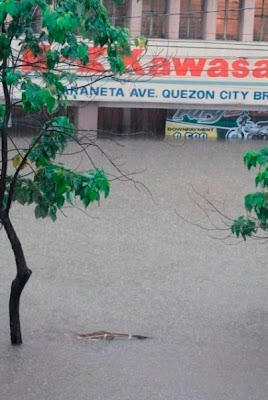
Araneta Avenue in Quezon City


Wilson Ave. in Greenhills, San Juan


Flooded street and cars near Xavier School


The next set of pictures was from a resident in a Gawad Kalinga (GK) site where I presently serve - GK Melchor Aquino in Barangay Sta. Lucia, Quezon City. By God’s grace, there were no fatalities in that GK site. Other parts of the same barangay were not as fortunate as several people living in nearby streets died and/or lost their houses in the rushing flood waters.


GK Melchora during the height of the heavy rains and flooding last Sept. 26


Rains have subsided but the flood waters remained high


As the waters receded, the extent of property damage is made very clear


Filipinos as a people are extremely resilient….


…so the process of rebuilding lives starts again and goes on….


Other forwarded pictures to me include:


This photo of an ill fated family fighting for their lives
clinging to their destroyed house floating through the
Marikina river


An aerial view of the heavy rains' destructive aftermath


Stranded city dwellers bravely traversed the flood waters as rescue efforts ensued


President Gloria Macapagal-Arroyo was quoted in saying that ‘Ondoy’ (Ketsana) and the flooding were “an extreme event” which “strained our response capabilities to the limit but ultimately did not break us.”

Well I have news for our transactional leader in Malacaňang Palace. This ‘extreme event’ is more likely the norm of things to come considering the unabated logging in the Sierra Madre mountain range to the east of Metro Manila, uncontrolled housing development in ecologically critical or unsafe areas, the over silted and polluted state of Laguna de Bay and Marikina river and the solid waste problem which besets the national capital region.

And what response capabilities was she talking about??? The government barely had any rubber boats to rescue people from the roofs of their homes, much less other hi-tech rescue equipment to ferry people to safety. The truth of the matter was the government was caught flat footed in what could have been the greatest hour of public service by the Arroyo administration.

But she was right about one thing. The Filipinos are a resilient lot. The storm didn’t break our spirit as a nation. It was also during these tragic times that the best of the Filipino citizenry came out.

It is my hope that this unity of the Filipino people especially during times of adversity be properly channeled and sustained not only in rebuilding efforts but in responding responsibly and decisively with regard to the abovementioned concerns which ultimately involved global warming and climate changes.

This hope is my post birthday wish and pressing advocacy.

Another storm is brewing on the horizon….

Let us heed nature’s warnings….before it’s too late.


Labels: ,